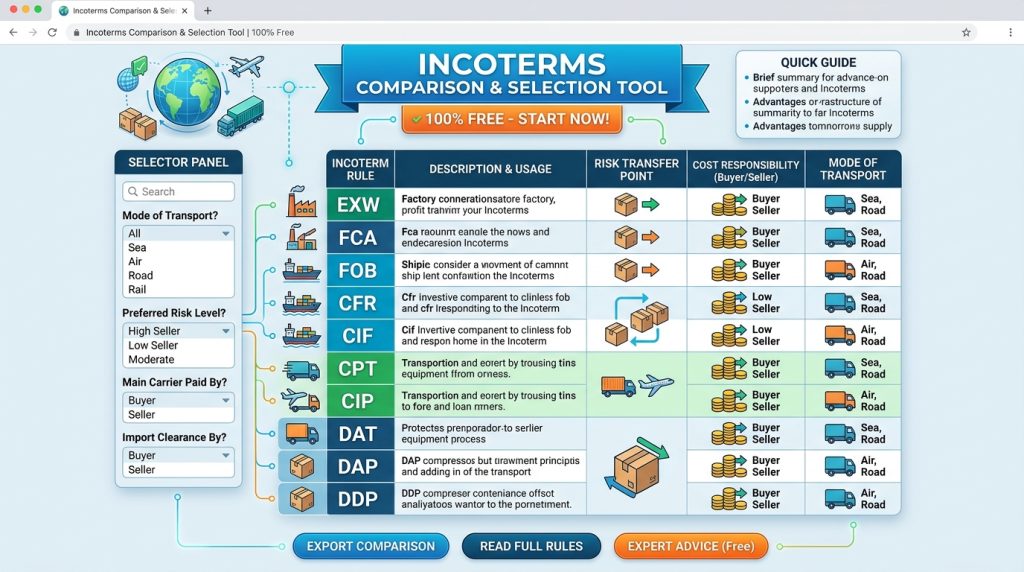
 Navigating the waters of international trade needs a clear map. In worldwide logistics, that map is drawn by Incoterms (Worldwide Professional Conditions). Founded through the Global Chamber of Commerce (ICC), these eleven 3-letter acronyms outline the precise second obligations, costs, and liabilities shift from the vendor to the client. Misunderstanding these terms may lead to unpredicted expenditures, stranded cargo, and lawful disputes.
To develop a resilient source chain, firms have to learn how these guidelines dictate monetary responsibilities and liability boundaries.
The Foundation of worldwide Trade: Who Pays for What?
At its core, each Worldwide cargo requires a series of monetary milestones. These include things like nearby trucking, export customs clearance, Intercontinental ocean or air freight, import duties, and last mile supply.
Different Incoterms distribute these bills throughout a spectrum. On a single Serious, Ex Functions (EXW) destinations virtually all money burdens on the customer. On the other Severe, Delivered Duty Compensated (DDP) needs the seller to manage and pay for almost everything, including import taxes in the vacation spot.
Selecting the correct time period needs a granular breakdown of logistics capabilities. For instance, a customer using a extremely optimized freight forwarding community may possibly desire No cost On Board (FOB), allowing for them to regulate Worldwide freight prices as opposed to depending on the seller's markup. To map out these financial obligations precisely, logistics administrators regularly rely on an Incoterms cost and risk comparison to visualize wherever their monetary accountability finishes and their lover's begins.
The Essential Pivot: Knowledge Risk Transfer
Whilst controlling expenditures is important for budgeting, handling chance is significant for business continuity. A typical false impression in world trade is the fact that threat and value often transfer at the exact same geographic position. Actually, specified phrases independent the two.
Consider Carriage and Insurance policy Paid To (CIP) or Price and Freight (CFR) as examples. Less than these procedures, the vendor pays for that freight right up until it reaches the vacation spot port. Nevertheless, the risk of destruction or reduction transfers to the buyer The instant the goods are handed around to your carrier for the origin. If a container is destroyed at sea beneath a CFR settlement, the customer have to file the insurance policy claim and bear the reduction, even though the seller compensated to the ocean voyage.
Simply because cargo insurance plan policies and local maritime laws vary wildly, offer chain leaders must set up a demanding internal protocol. Utilizing a focused Incoterms risk transfer guide aids procurement groups detect hidden vulnerabilities, making certain that cargo insurance plan coverage aligns flawlessly with the precise instant legal responsibility modifications fingers.
Navigating Customs Clearance and Documentation
Over and above Bodily motion and financial risk, Incoterms explicitly dictate who handles the red tape. Customs compliance is becoming significantly complex, with stringent enforcement of forced labor regulations, environmental tariffs, and digital documentation.
Under conditions like No cost Provider (FCA), the vendor is chargeable for export clearance, making sure the products are legally allowed to leave the state. Having said that, the customer handles the import course of action.
The dynamic flips fully below DDP. For any seller, providing DDP conditions might be a powerful selling place since it creates a seamless experience for the customer. But, it exposes the vendor to important regulatory dangers inside a overseas place in which They could not Possess a lawful entity to act as being the Importer of Record (IOR). If customs authorities seize the goods due to poor classification, the seller faces penalties and delays, specifically impacting their bottom line.
Strategic Collection: Aligning Conditions with Enterprise Plans
There isn't any just one-size-fits-all Incoterm. Your best option will depend on your leverage, operational footprint, and hazard tolerance.
• When to lean toward Seller-Controlled terms (e.g., CIF, DDP): In case you are a customer seeking a hassle-free, predictable landing Price, or maybe a seller seeking to offer quality company while managing the logistics margin.
• When to lean towards Consumer-Managed phrases (e.g., FCA, FOB): For anyone who is a highly skilled importer with quantity-based mostly transport special discounts and want comprehensive visibility about transit periods, routing, and carrier selection.
By auditing your shipping and delivery facts and assessing the abilities of the logistics partners, you can transition from blindly accepting regular contract phrases to strategically negotiating Incoterms that shield your margins.
Optimizing Fashionable Offer Chains
As supply chains mature additional sophisticated, clarity remains your very best protection from disruptions. A single miscommunicated expression can lead to Many bucks in port demurrage expenses or uninsured cargo losses. By extensively educating your procurement, authorized, and logistics groups around the nuances of Charge allocation, liability transfer, and customs obligations, you make certain your Global shipments shift easily from origin to spot.